The Bosch Foundation: On our last day in Stuttgart we visited The Robert Bosch Foundation office first to learn about their research on diversity in Germany. The Bosch Foundation was founded in 1904 and focuses on three key area education , health, and global issues. Global issues include how to live in diverse societies, migration, democracy, peace, and climate change. Dr. Ferdinand Mirbach started his presentation with the question Does diversity enhance or threaten society? This question was asked in a survey they did in 2019 using a barometer measuring Islamophobia, Lookism (body types, shape),racism, ageism, gender homophobia, and disability. 3,000 participants ages 16 and up, from every region in Germany answered 100 questions in phone interviews. He shared the results and breakdown of responses.
Results Breakdown: Overall 68% think there is a good acceptance of diversity
What we learned: There are big regional differences in acceptance. Northern and western regions of the country are more accepting, liberal, and less religious.
The eastern region which was formerly the GDR (German Democratic Republic) pre-unification, did not have any interactions with ethnic or diverse groups, and migrants for over 40 years due to the Cold War. Their results were much different, and the opposite of the west in regards to acceptance. In this region women, younger, educated, and politically left are more accepting of diversity than those older, low income, low education, politically right. The Americans in the group weren’t surprised because the results were similar to how groups in the U.S view DEI.
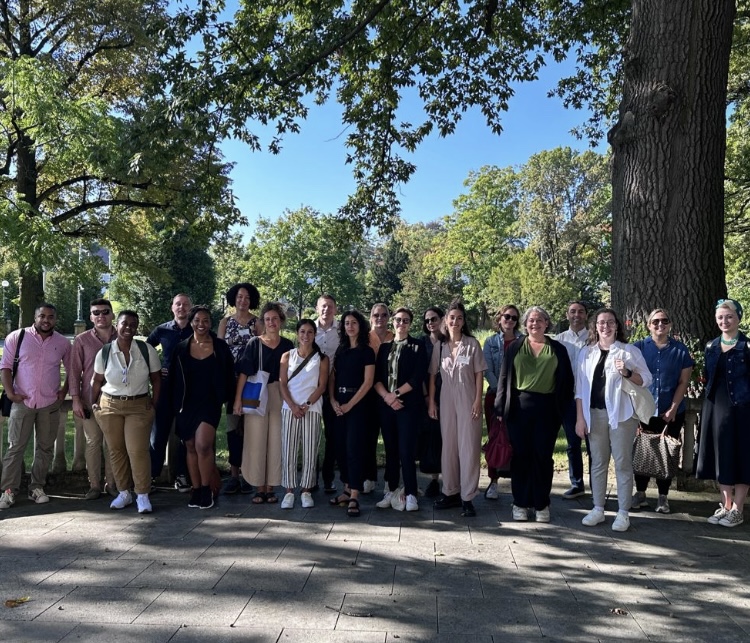
Frum O Kulturen Stuttgart: The very last stop for the group was at the Forum of Cultures Stuttgart. Forum of Cultures is a non-profit that helps bring together hundreds of migrant organizations in the Stuttgart region. They offer services and programming such as cultural festivals and events, workshops, conferences, and publishes their own magazine for communities. The goal is to bring together different cultures and civic organizations to promote intercultural diversity. Some of their influence extends outside of Stuttgart. At the federal level they were a founding member of the Federal Council for Cultural Diversity. This council was created to support cultural institutions and organizations that work with them.
Some of the challenges mentioned by team leader Daniel Machalos was that Germans want the events and programming such as art, shows, food, and music, but are not willing to support the people from minority communities. He told us “Germans think they are friendly and helpful, but they are not German, they are not us.” It made me think about my interactions with locals this week who were immigrants, refugees, and people of color. There was a lack of belonging in their lived experiences and a feeling of being othered. Two young Afro-German women I met on the train in Stuttgart, shared some of their experiences in Germany with me and two Black women from our group. I also spoke with a young Afro-German male who was born in New York, and a Ulkrainian refugee who speaks eight languages and shared some of the microagressions and discrimination they faced. Although everyone I talked to did their best to adjust or assimilate, they still felt like they didn’t belong. See my post on Membership and Belonging for more details on my interactions with locals, and the way Anti-Blackness and White Supremacy impacts migrants in Germany.
 The Paradox
Leave a comment